


Medial Elbow
The elbow joint is where your humerus (upper arm bone) meets your radius and ulna (the two bones in the forearm).
The orientation of the bones forming the elbow joint produces a hinge joint which allows for extension and flexion of the forearm.
Also, the superior radio-ulnar joint (just below the elbow) allows supination and pronation of the wrist. This adds a level of complexity to the elbow joint.
What do I need for Elbow pain? View all


Our Expert Physio
Cameron Lillicrap has spent over 40 years on both sides of elite sport, as an international rugby player and as Australian Rugby's Team Physiotherapist, trusted to keep some of Australia's most successful athletes on the field. His practical, focus-on-what-you-can-do approach is why people seek his advice when their rehab isn't working. He knows what's needed to get you back 'in the game'.
We asked Cam about Elbow pain.
Here's what he said...
Q&A with Cam
What are the most common elbows problems you see in the Physio Clinic?
Tennis Elbow and Golfer's Elbow - by a long way. Both are tendon overuse conditions, just on opposite sides of the joint. Tennis Elbow affects the lateral epicondyle on the outside; Golfer's Elbow hits the medial epicondyle on the inside. Both come from the same basic problem: repetitive loading through the forearm muscles without enough recovery.
The symptoms are very similar regardless of which side - a weak, painful grip, point tenderness directly on the bony bump at the elbow, and pain with forearm rotation movements like turning a key or a door handle.
Despite the names, I see these far more often in tradies and gym-goers doing repetitive bicep curls than I do in actual tennis or golf players. If your work or training involves repeated gripping and forearm rotation, you're in the risk group.
What's the best way to manage Medial elbow pain?
Before you start treating it, rule out a partial tendon tear or tendinopathy. Both need different management to a straightforward strain, so getting that clarity early saves time.
Once you know what you're dealing with, management covers pain control and progressive loading:
- A tendon de-loading compression strap takes stress off the tendon during activity - worth using early while things are still irritated
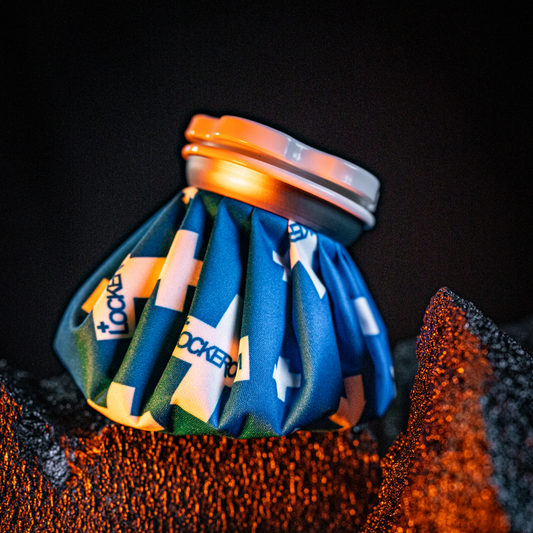
- Ice locally with an Ice Mate Mini to manage pain and inflammation
- Release forearm muscle tension with a Pocket Physio The forearm flexors are almost always contributing to the load on the medial tendon
- Follow a progressive tendon strengthening program with a Pocket Physio Twist - the key word is progressive; tendons respond to gradual loading, not aggressive early strengthening
- Build grip strength back with a Pocket Physio Squeeze as you progress through rehab
Rest alone won't fix this. The tendon needs to be progressively reloaded to adapt and strengthen... that's what gets you out of the cycle of it flaring up repeatedly.
Are there any other type of elbow injuries you treat?
Yes - hyperextension injuries and dislocations, both common in collision sports. The mechanism is usually a tackle, a fall onto an outstretched arm, or direct contact with an arm that's already fully extended. The elbow just isn't built to absorb force in that position.
A dislocation needs to be reduced (the joint relocated) and then immobilised to let the pain and swelling settle. Hyperextension injuries are less dramatic but still painful and may also need a period of immobilisation depending on severity.
The critical thing with both is what comes after the immobilisation: early, gentle mobilisation to restore full range of motion. Elbows are notorious for stiffening up if you leave them too long without movement. Your therapist needs to guide this phase carefully. Push too hard and you aggravate it, do too little and you lose range permanently.
When can I return to play after a hyperextended or dislocated elbow?
When function returns - meaning you've got most of your range of motion back and your strength is close to the other side. That timeline is typically 2 to 6 weeks, but the elbow is a joint that doesn't like being rushed or ignored in equal measure.
The approach that works best is what I call gentle but persistent...light, predominantly pain-free movement in small doses several times a day, rather than one big session that flares it up. Elbows respond well to frequent, low-load exposure. Stay consistent with that and you'll get your range back faster than resting and waiting.
Related Articles View all
-

Pocket Physio MAX
Who Needs a Pocket Physio Max? Tight muscles don't wait for a day off. They show up mid-run, mid-set, mid-ride. Right when you need your body to do what you're...
Pocket Physio MAX
Who Needs a Pocket Physio Max? Tight muscles don't wait for a day off. They show up mid-run, mid-set, mid-ride. Right when you need your body to do what you're...
Read more -

-

Your Shoulder Isn't the Problem
Why Your Shoulders Feel Weak. It's Not Your Shoulders If you've ever struggled to lift something overhead, felt your shoulder "give out" mid-throw, or noticed your arm tiring faster than...
Your Shoulder Isn't the Problem
Why Your Shoulders Feel Weak. It's Not Your Shoulders If you've ever struggled to lift something overhead, felt your shoulder "give out" mid-throw, or noticed your arm tiring faster than...
Read more


